What Is a Public Product Roadmap? Examples & Best Practices
· 10 min read · by the Loopful team
Every product team gets the same question, over and over, in slightly different words.
"Are you going to build this?"
It arrives in support tickets, sales calls, community threads and replies to your release emails. Answering it one person at a time is expensive, and answering it inconsistently is worse.
A public product roadmap is the cheapest way to answer it once.
What is a public product roadmap?
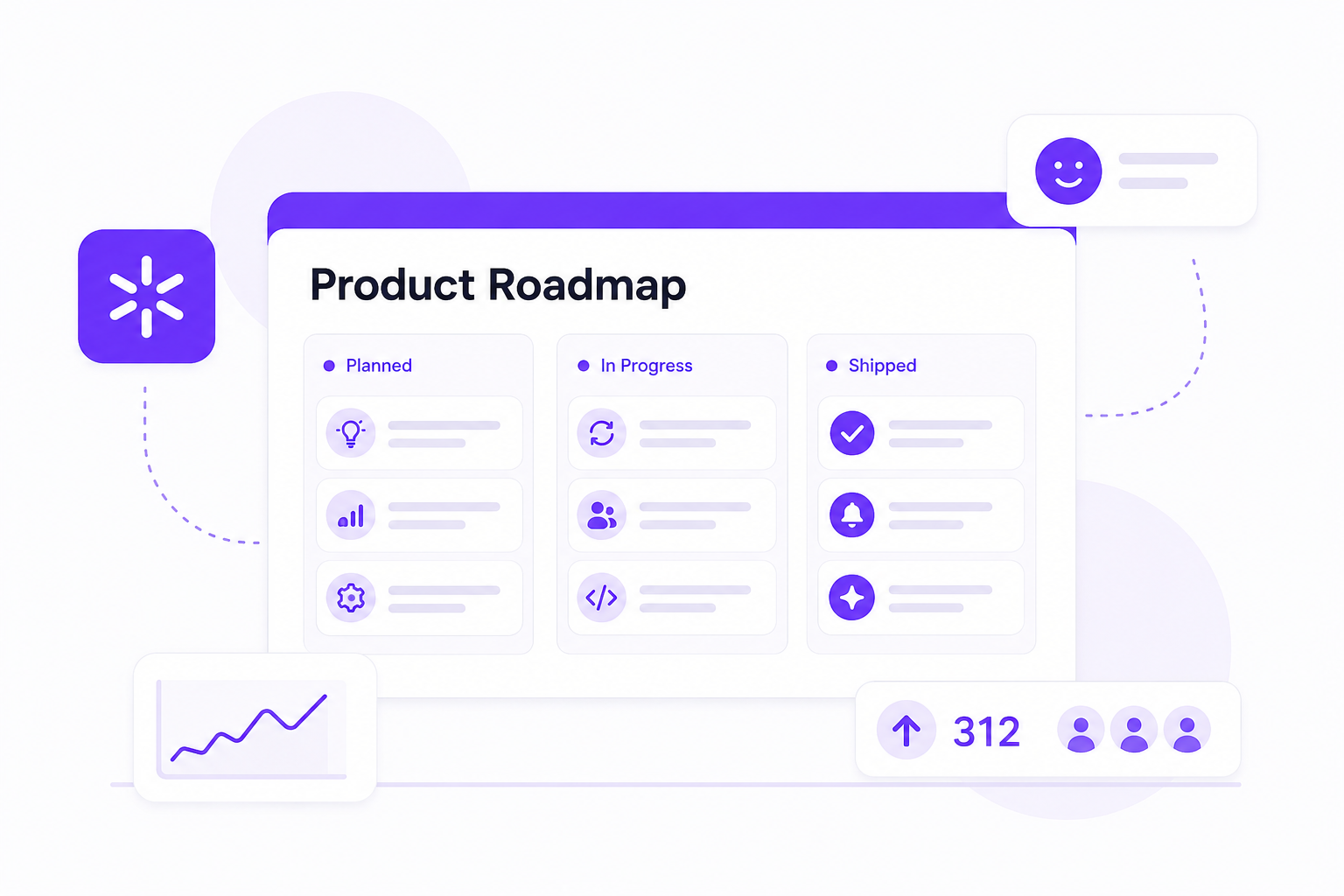
A public product roadmap is a customer-facing page that shows what your team is working on, what's coming next, and what has already shipped.
That's the whole idea. It isn't a project plan, and it isn't your internal backlog with the confidential parts deleted. It's a communication surface: a short, readable summary of your product direction, written for the people who use the product rather than the people who build it.
A useful public roadmap usually shows:
- The items themselves — features, improvements and fixes, described in customer language
- A status for each one, such as planned, in progress or shipped
- Some context about why an item matters or what problem it solves
- A way to react — voting, commenting, or subscribing for updates
Notice what's missing. There are no engineering tickets, no sprint numbers, no internal codenames, and usually no hard dates.
What a public roadmap is not
It's worth being precise here, because most of the trouble teams run into with public roadmaps comes from confusing it with something else.
It is not a delivery schedule. A roadmap communicates intent and sequence. The moment it starts implying committed dates, you've published a contract you didn't mean to sign.
It is not your internal roadmap. Internally you track dependencies, capacity, technical debt and half-formed bets. Publishing that raw would be noisy for customers and risky for you.
It is not a feature request board. A board is where demand comes in. A roadmap is where your decisions go out. They're connected, but they answer different questions: a board answers "what do people want?", a roadmap answers "what are we doing about it?"
Public roadmap vs. internal roadmap
Most teams need both. They serve different audiences and are edited at different rhythms.
| Internal roadmap | Public roadmap | |
|---|---|---|
| Audience | Product, engineering, leadership | Customers, prospects, community |
| Detail level | Tickets, estimates, dependencies | Outcomes in plain language |
| Timeframes | Sprints, quarters, capacity | Now / Next / Later, or status only |
| Changes | Daily | Weekly or monthly |
| Includes | Technical debt, experiments, bets | Things you're comfortable being held to |
The public roadmap is a filtered view of the internal one. Not a mirror, not a marketing page. A filtered view.
Why publish a roadmap at all?
It reduces the same conversation happening ten times
The most immediate benefit is boring and enormous: fewer repeat questions. When customers can check a page to see whether something is planned, your support inbox stops carrying that load.
It closes the feedback loop
Collecting feedback creates an obligation. People who take the time to write a request want to know what happened to it. A roadmap is the visible half of that answer, and a changelog is the other half. Without them, feedback collection becomes a place where ideas go quiet, and participation drops off.
If you're still building that pipeline, our guide on how to collect, manage and prioritize feature requests covers the upstream half of this.
It helps sales without a sales pitch
Prospects ask about missing features constantly. A public roadmap lets a salesperson answer honestly, with a link, instead of over-promising in a call. "It's on the roadmap" means something when there's a page behind it.
It creates a reason to come back
A roadmap and changelog give customers a low-commitment way to stay engaged with your product between releases. For many teams, the roadmap is one of the most-visited pages they own.
It signals momentum
An active roadmap tells prospects that the product is being built, not maintained. For a small company competing against larger incumbents, visible velocity is one of the few advantages you have. It's also indexable content, which quietly helps you show up for searches about features you're planning.
The risks and how to handle them
Public roadmaps have real downsides. They're all manageable, but pretending they don't exist is how teams end up quietly deleting the page a year later.
Competitors can see it. They can. In practice, knowing what you intend to build is far less valuable than being able to build it, and your customers were going to tell them anyway. If something genuinely is a strategic surprise, leave it off. A roadmap doesn't have to be complete to be honest.
Customers will read dates as promises. They will, even soft ones. The fix is to avoid publishing dates you don't control. Sequence is safer than schedule.
Plans change, and you'll look inconsistent. Change is normal; silence is what damages trust. Moving an item and explaining why in a sentence costs almost nothing. Letting it sit in "In Progress" for eight months costs a lot.
It goes stale. This is the most common failure, and the most fatal. An abandoned roadmap is worse than no roadmap: it's a public record that you stopped paying attention.
Four public roadmap formats, with examples
There's no single correct layout. Pick the one that matches how your team actually plans.
1. The status board
The most common format, and the best default. Three or four columns, each item in one of them. You can see a live demo of such a roadmap here.
PLANNED              IN PROGRESS          SHIPPED
Slack integration    Bulk CSV export      Dark mode
SSO (SAML)           Mobile web fixes     Weekly digest email
Custom domains       API rate limits      Comment mentions
Best for: most SaaS products, especially small teams. Why it works: it's instantly readable, and it never implies a date.
2. Now / Next / Later
A horizon-based roadmap. Instead of statuses, items sit in buckets of decreasing certainty.
NOW                  NEXT                 LATER
(this quarter)       (next 1-2 quarters)  (direction, not commitment)
Reporting redesign   Public API v2        Native mobile apps
Audit logs           Role permissions     Workflow automation
Best for: teams that want to communicate strategy, not just delivery. Why it works: the vagueness is deliberate and honest. "Later" is understood as an intention, and nobody expects a date.
3. The theme roadmap
Group work by the outcome it serves rather than by feature.
MAKING ONBOARDING FASTER
  · Guided setup checklist (in progress)
  · Sample data on signup (planned)

GIVING ADMINS MORE CONTROL
  · Role-based permissions (in progress)
  · Audit log export (planned)
Best for: products where individual features are hard to explain in isolation. Why it works: it tells customers what you're trying to achieve, which survives changes in how you achieve it.
4. The timeline roadmap
Quarters or months along an axis, items placed against them.
Best for: enterprise products, regulated industries, and situations where customers need to plan their own work around your releases. Why it works: it answers the question customers actually have, when?, but it's the riskiest format by a wide margin. Only publish it if you can hit the dates most of the time, and use quarters rather than weeks.
Add a fifth column: Not planned
Whatever format you choose, consider a place for things you've decided against. A clear "not planned" with one line of reasoning is more respectful than leaving a popular request in limbo indefinitely, and it keeps everything else on the board meaningful.
If you want to see a working roadmap rather than a diagram, the Loopful demo portal has a live one alongside a feedback board and changelog.
How to build a public product roadmap in 6 steps
1. Decide what belongs on it. Not everything you build. Customer-visible work, yes. Infrastructure, security work and internal refactors usually don't belong unless customers asked for them.
2. Choose your granularity. Roughly 10–25 items is a good target. Fewer looks abandoned; many more becomes a backlog dump nobody reads.
3. Pick statuses you can maintain. Three or four. Every extra status is a decision you'll have to make repeatedly, and an ambiguity customers will ask about.
4. Rewrite everything in customer language. "Implement webhook retry queue" becomes "Retry failed webhooks automatically." If a customer can't tell whether an item affects them, it isn't finished.
5. Connect it to your feedback source. Roadmap items should link back to the requests that prompted them, so the people who asked can be notified when things move. This is the step that makes the whole system compound, and the reason a roadmap works better inside a feedback tool than in a standalone document.
6. Set an update rhythm and keep it. Fifteen minutes every other Friday is enough for most teams. Put it on a calendar, because "when we get to it" reliably means never.
Public roadmap best practices
Write outcomes, not tickets. Customers care what changes for them.
Avoid dates unless you can hold them. Sequence and status carry most of the useful information with a fraction of the risk.
Move things backwards in public. If something slips out of "In Progress," say so, briefly. Visible honesty is worth more than a tidy board.
Let people vote and comment on roadmap items. It turns a broadcast into a conversation, and it tells you which planned item to start with. Just remember that a vote is a signal not a mandate, we wrote about when feature voting works and when it doesn't if you want the longer version.
Say no clearly. A short "not planned, here's why" protects your credibility better than silence.
Ship the loop. When an item moves to shipped, publish a changelog entry and notify everyone who voted for or commented on it. This is the single highest-return habit in the whole system: it's the moment a customer learns that talking to you produces results.
Keep the door open next to it. A roadmap without a way to submit new ideas is a one-way announcement. Put the feedback board one click away.
Don't publish everything. A roadmap is edited. It's allowed to be incomplete, as long as what's on it is true.
How to tell whether it's working
You don't need a dashboard for this, but a few signals are worth watching:
- Support tickets asking "is X planned?" should fall
- Roadmap page visits per active customer should be stable or rising
- Votes and comments on roadmap items, engagement, not just traffic
- The share of shipped items that came from customer requests
- Time items spend in each status; a growing "In Progress" column usually means the board is drifting from reality
Common mistakes
Publishing the backlog. Two hundred items with no ordering isn't transparency, it's noise.
Using it as a marketing page. If everything is exciting and nothing is boring, customers stop believing it.
Letting one loud customer set the order. Segments, revenue and impact belong in the decision. Volume alone doesn't.
Never removing anything. Items that have sat untouched for two years should be closed with a reason, not left as decoration.
Keeping it in a separate tool from your feedback. When the roadmap lives in a document and the requests live somewhere else, the link between "you asked" and "we shipped" breaks, and that link is the entire point.
How Loopful handles public roadmaps
In Loopful, the roadmap isn't a standalone page you maintain by hand. It's the visible middle of the loop.
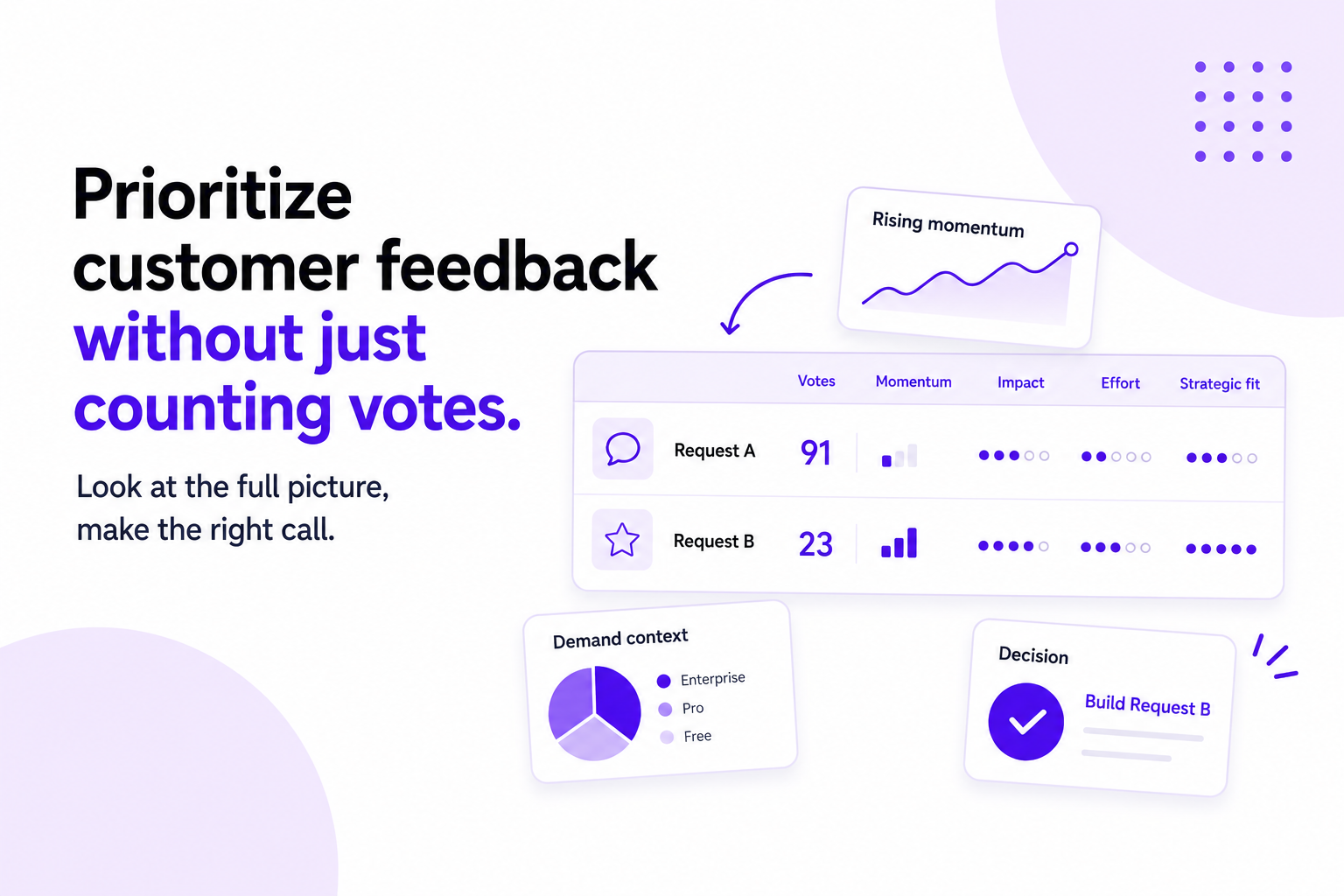
Customers submit ideas and vote on public or private feedback boards. You prioritize using demand, customer segments, and impact and effort scoring, rather than raw vote counts. Items you decide to pursue move onto the public roadmap with the status you choose, using your own custom statuses if the defaults don't fit.
When work ships, you publish a changelog entry, link the requests it resolves, and everyone who voted or commented is notified automatically. The customer who asked eight months ago hears about it without you having to remember who they were.
The whole portal, board, roadmap and changelog can live on your own domain, be embedded in your product, or open from a feedback widget. If you're comparing options, our guide to choosing customer feedback software covers what to look for, and the comparison page shows how Loopful lines up against the usual alternatives.
FAQ
Should a startup have a public roadmap?
Usually yes, and earlier than you'd think. When you have few customers, each one is high-value, and a roadmap is a cheap way to show them they're being heard. Start with five to ten items and a status board.
Won't competitors copy my roadmap?
Some will look. Execution, timing and distribution are what actually decide outcomes, and anything truly sensitive can simply be left off. Most teams find the trust they gain from customers outweighs the visibility they give competitors.
Should I put dates on a public roadmap?
Only if your customers need to plan around your releases and you can hit dates consistently. Otherwise use statuses or Now / Next / Later. Missed public dates cost more trust than vague ones.
How often should I update it?
Every two weeks is a good baseline; monthly is the minimum. Consistency matters more than frequency, a roadmap updated reliably once a month reads as maintained, while one updated erratically reads as abandoned.
What's the difference between a roadmap and a changelog?
A roadmap is forward-looking: what you intend to do. A changelog is backward-looking: what you actually shipped. Together they show the full loop, and each makes the other more credible.
Can a public roadmap be private to logged-in customers?
Yes, and for some products that's the better answer. A roadmap visible only to authenticated users gives you most of the trust benefits with none of the competitive exposure.