How to Collect Customer Feedback Inside Your SaaS
· 9 min read · by the Loopful team
The most useful thing anyone will ever tell you about your product is being thought right now, by someone four clicks into a workflow that isn't going well.
Most of it will never reach you.
Not because people don't want to tell you. Because telling you means abandoning what they were doing, hunting down your support address or your feedback portal, making an account somewhere new, and writing up an idea that felt obvious thirty seconds ago and now feels like homework.
Every step between having the thought and reaching you costs you feedback. Collecting it inside your product is mostly the work of deleting those steps.
In-product isn't just another channel
Three things change when feedback is given from inside the product.
The context is still on screen. Someone writing from your reports page can tell you what they were trying to do, because they're looking at it. The same person writing an email two days later sends you three sentences of summary and leaves out the part that mattered.
You hear from people who would never have emailed. Email and standalone portals quietly filter your feedback down to your most persistent users, which is not the same thing as your most representative ones. Lower the price of speaking and mildly annoyed people start bothering, which is where a lot of the useful material lives.
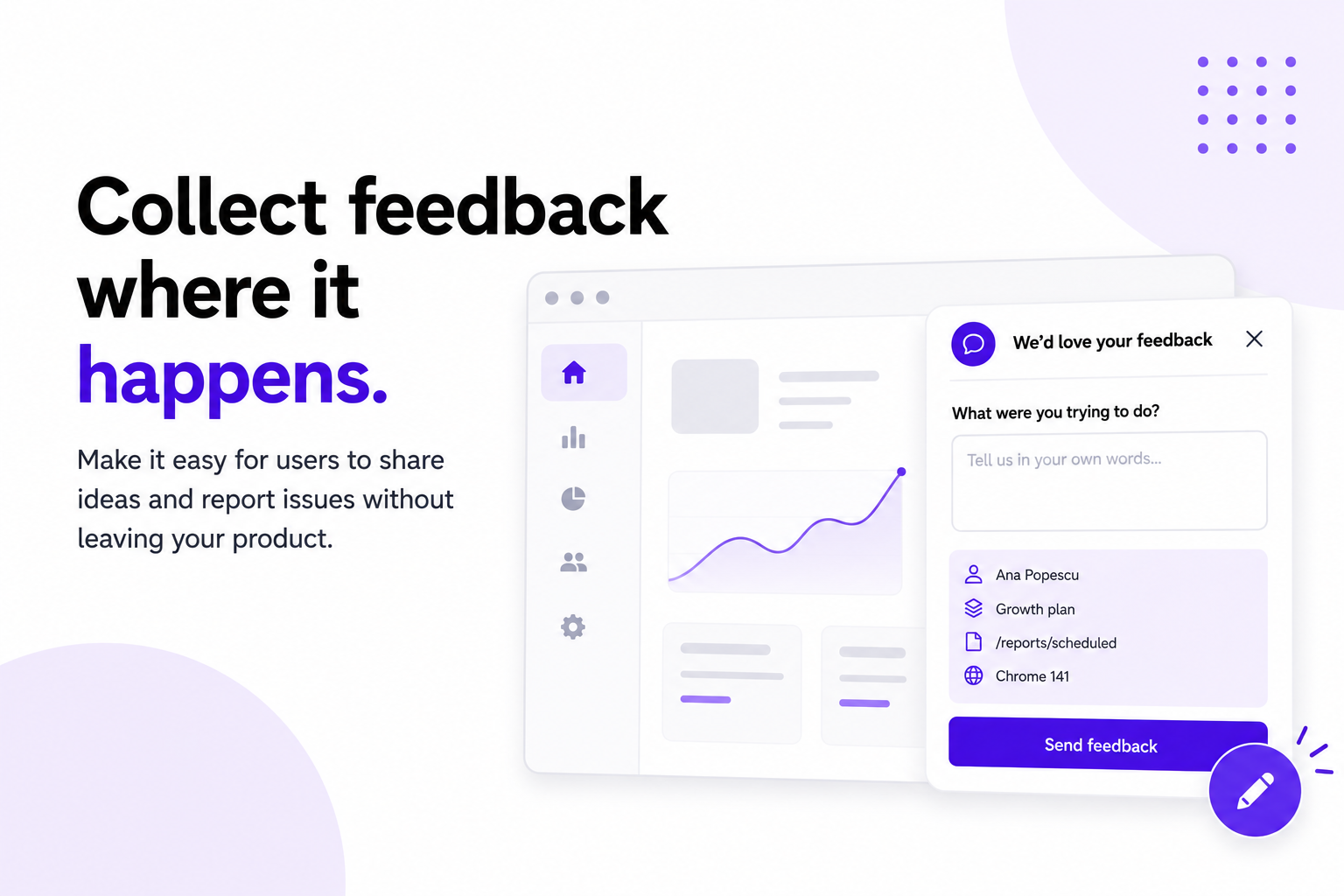
You can collect the boring half yourself. Who they are, what plan they're on, which screen they were on, which browser. None of that has to be typed by a customer, and all of it is what makes a request readable six months later.
The catch is the same proximity. A channel that can reach every user instantly is a channel you can wear out, and most of what follows is about not wearing it out.
Passive and active collection
Two different things get called in-app feedback, and they behave differently enough to plan separately.
Passive | Active | |
Who starts it | The user | You |
Looks like | A widget, a button, a feedback link | A prompt after an action, an in-app survey |
Volume | Lower | Higher |
Intent | High, they went looking | Mixed, you interrupted |
Cost to the user | Low | Attention |
Should be | Always available | Rationed |
Passive collection should stay available permanently. Active collection should be treated as a budget you spend down, because that's what it is.
Most teams get this backwards: no permanent entry point anywhere, and a survey modal every three weeks.
Where the entry points belong
Somewhere permanent, on every screen. A launcher in the corner, or your own button in the main navigation. Feedback buried in Settings collects feedback from people who were already in Settings.
At the point of friction. Empty states, plan limits, and the screens where the thing they want doesn't exist. "Nothing here yet" is a good place to add "tell us what you expected to find."
Where people go looking for answers. A help search that returns nothing is a feature request in a bad mood.
Inside the loop itself. Your roadmap and changelog are read by people actively thinking about your product, which makes them the best-qualified audience you have all week. Keep the submit box one click from both.
Keep the form to one field
Most in-product feedback dies in the form. Here's the version that kills it:
  Title *
  Category *            [ 11 options ]
  Priority *            [ Low · Medium · High · Critical ]
  Description *
  Steps to reproduce *
  Attachment
  [ Create an account to submit ]
And here's what you actually need:
 What were you trying to do?
  [                         ]
Ask one question, in one box. Every required field is a place to give up, and people give up at the second one.
Prompt for the problem, not the feature. Placeholder text does most of this work. "What were you trying to do?" gets you something you can act on. "Describe your request" gets you a solution somebody invented on the spot, without knowing your architecture or the other eleven requests that overlap with theirs.
Don't require an account. Making someone sign up to complain is a filter, and it filters out exactly the people you were trying to reach. If you need identity, take it from the session they're already in.
Surface similar posts as they type. Most people will happily vote on a request that already exists rather than write a fifth version of it, if you show them it's there. This is the cheapest deduplication you will ever do, because it happens before the duplicate exists.
Capture everything else silently. Plan, account, page, and anything about the state they were in. The customer's job is one sentence. The rest is yours.
Spend your interruptions carefully
Active prompts work, and they have a ceiling you don't discover until you've gone through it.
Reasonable moments to ask: after someone finishes something substantial, when they hit a limit, at an empty state, or when the same manual workaround shows up in their usage for the fourth week running.
Bad moments, in rough order of how much damage they do: during onboarding, mid-task, on first load, and immediately after an error you caused. That last one is worth being firm about. An error screen is a support moment, not a research moment. Fix it, say sorry, and ask another day.
Three rules cover most of the rest. Cap how often any one person can be prompted. Treat a dismissal as a no that lasts months, not days. Never block the interface behind the thing you're asking.
Someone who dismisses a prompt has told you something. Asking again next Tuesday tells them you weren't listening the first time, which is an odd message from a feedback request.
However many entry points, one destination
The widget is a channel, not a system. Feedback will keep arriving through support tickets, sales calls, and a colleague's Slack message about something a customer said last week.
If in-product submissions land somewhere different from the rest, you haven't added a channel, you've added a silo. Every team ends up holding a partial picture, and nobody can answer how many people have actually asked for this.
Route everything into the same place, then run the same process over all of it, whether a request arrived through the widget or through a sales call. What happens after it lands, merging the duplicates, adding customer context, deciding what's worth building, doesn't change based on which door it came through.
Not everything you collect is a feature request
Lower the barrier and the mix changes. Alongside requests you'll get bug reports, support questions, and a category that's easy to discard and shouldn't be.
Bugs get triaged separately and routed to engineering. Questions get answered, and if the same one arrives repeatedly, that's a product problem wearing a support costume.
And then there are the messages that describe friction without proposing anything. "I can never remember where the export lives." Nobody votes for these, they don't fit a board neatly, and they're frequently the most valuable thing in the pile, because they describe the problem instead of guessing at the fix.
The failure specific to this channel
In-product feedback has a decay pattern that email doesn't.
Someone who wrote you a long email will wait weeks for a reply, because they invested something. Someone who typed one line into a widget between two tasks finds out very quickly whether it goes anywhere, and if nothing comes back, they stop. Low-friction channels are easy to use and easy to abandon.
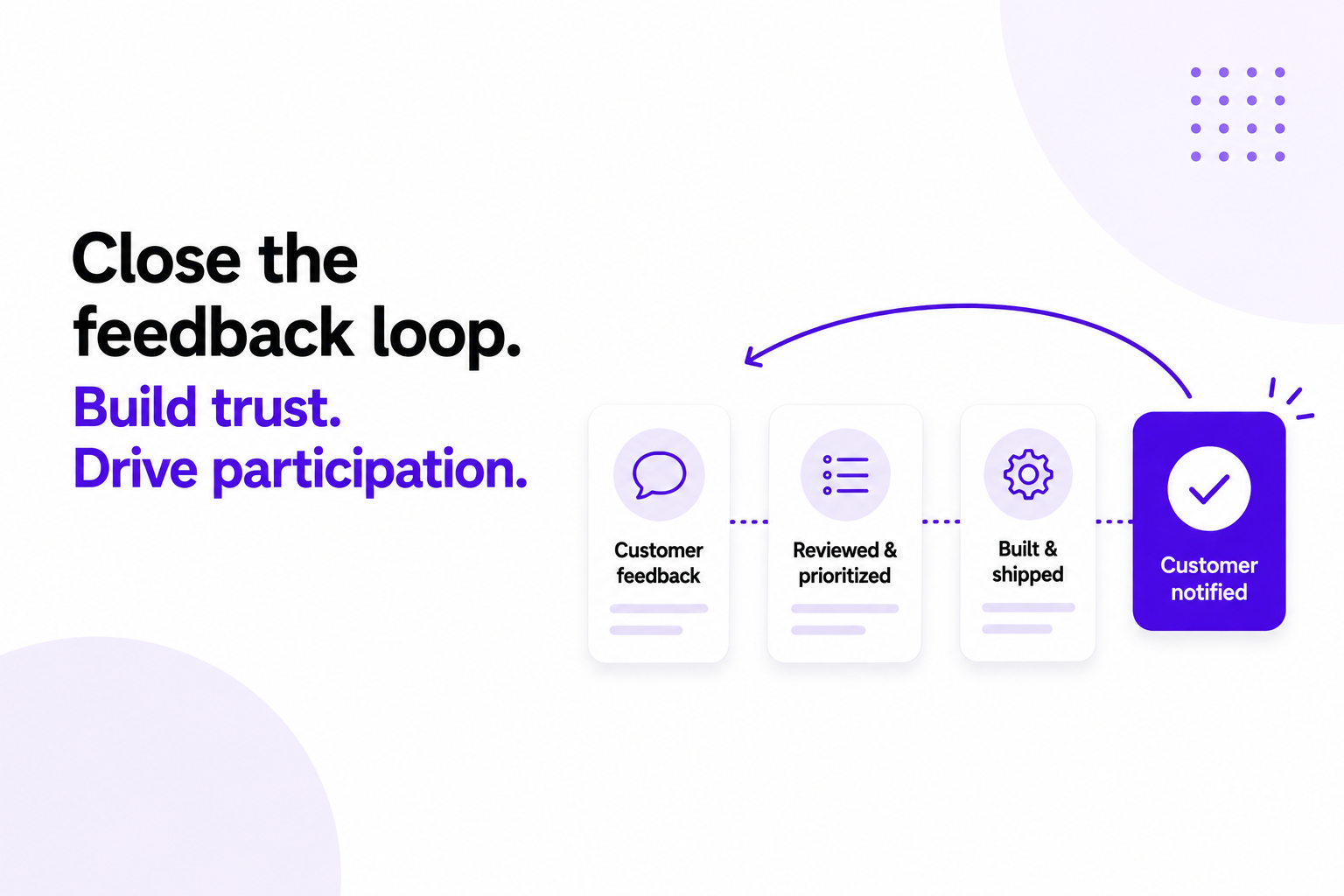
So the cheap part of the work is collecting. The part that keeps the channel alive is telling people what happened to what they said, which mostly means a visible status, an honest no when it's a no, and a message when the thing ships.
How to tell whether it's working
Submissions from accounts that had never given feedback before, because reaching people who wouldn't have emailed is the actual job
Dismissal rate on any prompt you run, which is the receipt for your interruption budget
Duplicate rate, which should fall once similar posts surface as people type
The share of submissions that get a status, a reply or a merge rather than sitting untouched
Common mistakes
The eleven-field form. Built to make triage easier, paid for entirely by the customer, and it costs you most of the submissions you were hoping to triage.
Hiding it in Settings. If somebody has to go looking, you've rebuilt the portal you were trying to replace.
Prompting during onboarding. Someone four minutes into your product has opinions about your signup flow and nothing else. Ask them about the signup flow, then leave them alone.
Letting the widget become an accidental support desk. People use whichever box is nearest. Decide in advance where questions get routed, or your product team spends Thursday answering how-to's.
Collecting in-product and storing it separately. A widget writing to its own database is a second inbox, and second inboxes are how "we already knew about that" becomes something you find out too late.
How Loopful collects feedback inside your product
The Loopful widget is one script with no dependencies. Use the built-in launcher or point your own button at it, and it takes your brand color and theme.
Users post ideas, browse boards, and upvote without leaving the page, with or without an account depending on how you want it. Your roadmap and changelog are built into the same widget, so the answer to "are you building this?" is one click from the place they asked.
Similar posts appear as people type, which stops most duplicates before they exist, and anything that slips through can be merged in one click without losing votes or comments. Smart tags organize posts as they arrive, and you can moderate before anything goes public.
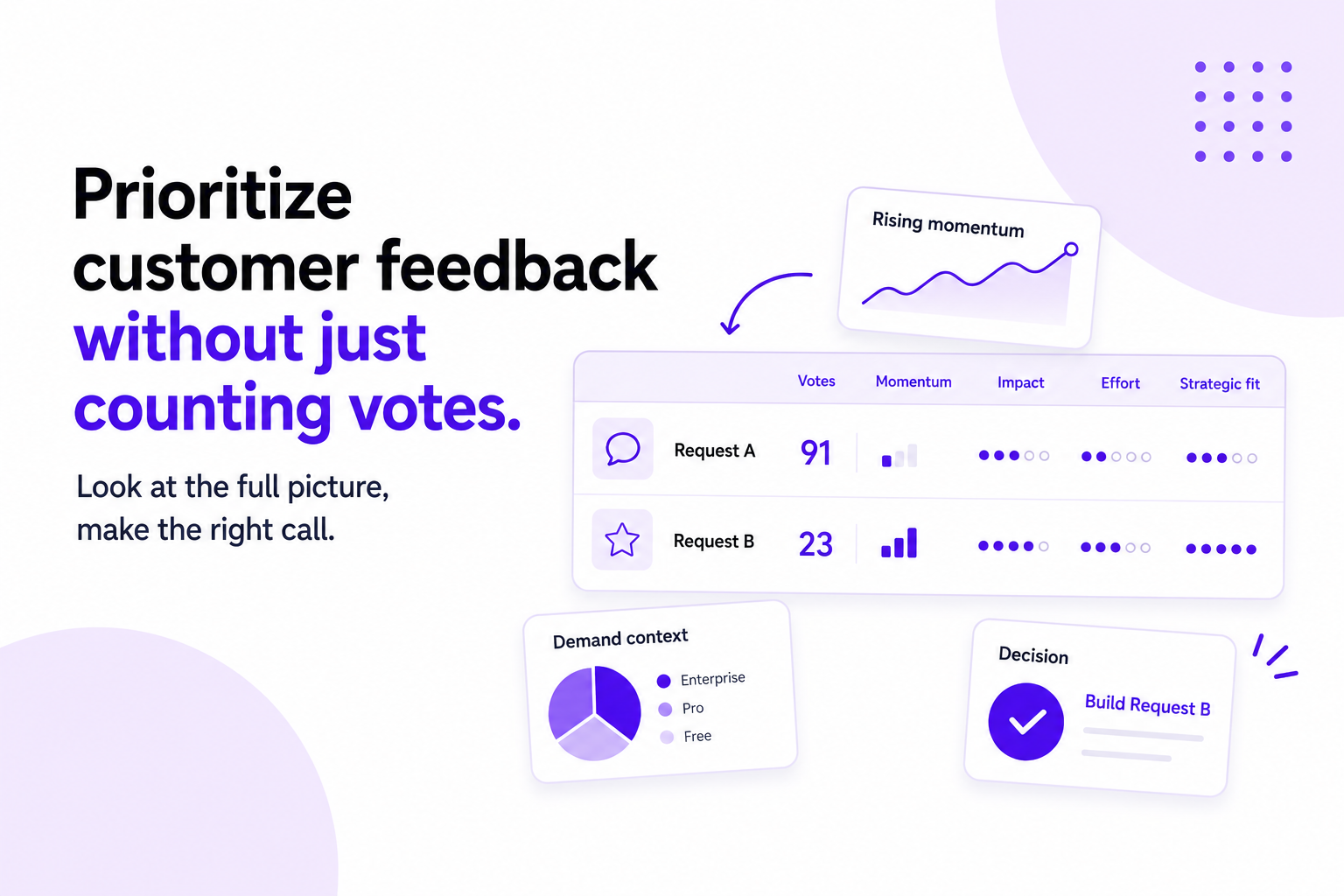
From there it's the same loop as everything else: insights show rising requests and how demand breaks down by segment, work you decide to pursue moves onto the public roadmap, and when it ships, everyone who voted or commented is notified automatically.
You can see the whole thing running in the Loopful demo portal.
FAQ
Should the widget be visible to every user?
Start broad unless you have a specific reason not to. Restricting it by plan or role feels prudent and mostly just narrows your input to the segment you already hear from. If volume becomes a real problem, moderation is a better lever than access.
Won't we be flooded with low-quality feedback?
Less than you expect, and it's the good kind of problem. Duplicate surfacing and merging handle most of the noise, and moderation catches the rest. A quiet board is the harder problem to fix.
Should in-product submissions be public?
Public boards let people vote and add context, which is most of the value. Private boards make sense when requests would reveal customer-specific work. You can run both, and route the widget at whichever fits.
Do I need in-app surveys as well as a widget?
They answer different questions. A survey asks what you chose to ask; a widget lets people raise what you didn't think to ask about. If you only run one, run the widget, because you can't vote for something that isn't there.
Should people be able to submit without logging in?
For most products, yes. You lose some context and gain submissions you'd otherwise be unlikely to see. If you're identifying users anyway, attach that automatically rather than making anyone type it.
Where should bug reports go?
Into your normal engineering triage, separately from feature requests. But collect them in the same widget or page: users can't be expected to know your internal routing, and asking them to pick correctly loses you the report.